The Wrapper Has No Clothes: How ChatGPT's Image Revolution Exposed the Moat That Was Never There
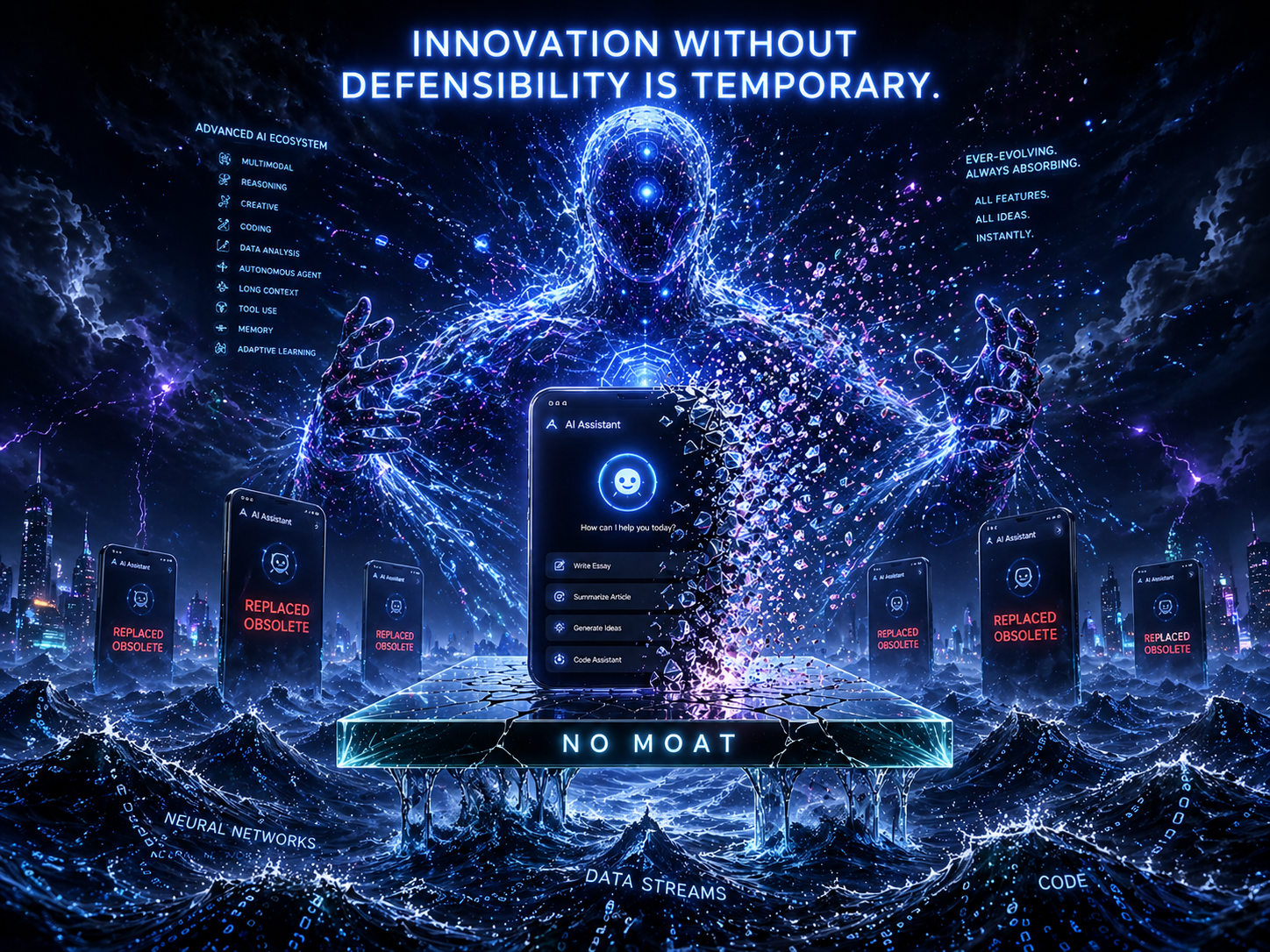
image courtesy of Gen AI - prompt author
Preamble:
A Thesis Confirmed in Real Time
In the study of technology markets, theoretical arguments about competitive dynamics occasionally receive the rare gift of empirical confirmation that is both immediate and unambiguous. The rise and rapid expansion of OpenAI's image generation capability - from GPT Image 1 in March 2025 through GPT Image 1.5 in December 2025 to the newly released GPT Image 2 in April 2026 - constitutes precisely such a confirmation. In the span of thirteen months, OpenAI released three successive image models, each materially more capable than the last, and in doing so delivered what may be the most instructive case study in recent technology history on the subject of competitive moats, platform consolidation, and the structural vulnerability of what the industry has come to call the "wrapper".
This essay opens with that case study not as a postscript or illustration, but as its central premise. What has happened to Midjourney, to Adobe's Firefly division, to Canva's AI ambitions, and to the broader ecosystem of image generation tools is not a story about image quality benchmarks or product roadmaps. It is a story about the absence of a moat - and about what it looks like, in vivid and consequential detail, when a platform provider decides to occupy territory that its dependent ecosystem had mistaken for its own.
The argument that follows is addressed to academicians researching AI market structure, IT consultants advising organisations on technology strategy, the gig economy for UI/UX designers, and university graduates preparing to build within or evaluate the AI-powered enterprise landscape. For each of these audiences, the image generation disruption is not merely interesting. It is a warning, a framework, and, ultimately, a guide.
I. The Scene of the Disruption: What GPT Image Actually Did
To appreciate the strategic significance of what has occurred, one must understand the precise nature of the capability that OpenAI deployed - and the speed at which it deployed it.
On 26 March 2025, OpenAI introduced native image generation within ChatGPT, powered by a new GPT-4o architecture. This was not simply another image generator added to a crowded market. It represented a fundamental architectural departure. Where every major image generation model before it - DALL-E 3, Midjourney, Stable Diffusion - operated on diffusion architecture, starting with random visual noise and gradually removing it to produce an image, GPT Image 1 employed an autoregressive design. It generated image elements sequentially, in a manner structurally analogous to how language models predict the next word in a sentence. The consequences of this architectural choice were immediate and significant: dramatically improved text rendering within images, superior instruction-following, and precise layout obedience - capabilities that matter enormously for the production of marketing assets, user interface mock-ups, branded graphics, restaurant menus, and the full spectrum of commercial visual communication.
The market's response was immediate and overwhelming. Within the first week of availability, more than 130 million users created over 700 million images. The sheer scale of that adoption - achieved within seven days - speaks to the depth of latent demand for precisely the capability that the preceding ecosystem of image generation tools had collectively failed to satisfy. The demand was not new. The frictionless delivery of it was.
OpenAI did not pause. By December 2025, GPT Image 1.5 arrived, generating images up to four times faster than its predecessor and introducing region-aware editing that could modify specific image elements while preserving faces, logos, and lighting. Then, on 21 April 2026 - less than a fortnight before the publication of this essay - GPT Image 2 was released, built on an entirely new architecture, retiring DALL-E 2 and DALL-E 3 entirely. Three models in thirteen months. The message embedded in that piece is not ambiguous: OpenAI has identified image generation as a strategic priority and has committed its full engineering and financial resources to dominating it.
The structural significance for the image generation ecosystem is profound. GPT Image 2 does not merely compete with Midjourney, Canva's AI features, Adobe Firefly, or the dozens of smaller image generation tools that populate the market. It competes from within a platform that already commands over 900 million weekly active users - a distribution advantage that no standalone image generator, however technically excellent, can replicate. As one analysis noted with blunt precision, this distribution power is a structural advantage that Midjourney, confined to Discord and its own platform, simply cannot match.
II. The Anatomy of the Wrapper, Revisited
The concept of the wrapper, introduced in earlier iterations of this analysis, acquires new clarity when examined through the lens of the image generation disruption. A wrapper, in the context of the AI industry, refers to any commercial product that overlays a user interface - however refined, however aesthetically accomplished - onto an existing AI capability without contributing proprietary value that is meaningfully difficult for the underlying platform provider to replicate.
This definition has a deceptively simple structure that conceals an important asymmetry of risk. The wrapper's business case rests, at every moment of its existence, on a single implicit assumption: that the platform provider will not choose to offer the same capability more conveniently, more cheaply, or more powerfully within its own native interface. It is, in the most precise sense, a bet against the rational economic behaviour of a better-capitalised counterparty.
That asymmetry was always present in the image generation market. Midjourney, for all its genuine technical excellence and aesthetic distinctiveness, was a product whose primary competitive advantage was access to a capability - high-quality text-to-image generation - that had not yet been offered natively within the conversational AI platforms through which most users were already operating. When that capability arrived natively, and at a quality level that addressed the most significant practical limitations of the prior tools - particularly text rendering, instruction precision, and integrated editing - the strategic position of every standalone image generator changed fundamentally.
Canva, whose AI image features were predicated on the continued absence of a comparable native capability within the conversational platforms its users already employed, faces what one technology analyst accurately characterised as an existential challenge to its ease-of-use proposition. Adobe, despite the genuine advantages of its Creative Cloud integration and its commercially safe Firefly training data, is now navigating a strategic environment in which its most powerful response - integrating GPT Image 1 directly into Firefly - simultaneously acknowledges the superiority of the competing capability it is incorporating. Figma, whose value proposition has always centred on being the professional designer's native environment, now contends with a platform that can generate pixel-perfect UI mock-ups on demand through conversational instruction, without requiring a designer to be present at all.
Each of these companies is confronting, with varying degrees of urgency, the same fundamental question: what do we have that cannot be absorbed into the expanding surface area of a foundation model provider's native platform?
III. The Economic Logic That Makes This Inevitable
The image generation case is not exceptional. It is exemplary. To understand why, one must examine the economic forces that drive foundation model providers to expand vertically, and why those forces make such expansion not merely probable but structurally inevitable for any capability that a third-party product has demonstrated to be commercially valuable.
Foundation model providers operate under a cost structure of striking asymmetry. The fixed costs of training, maintaining, and improving frontier-scale models are enormous - OpenAI, for example, projected an operating loss of approximately eight billion dollars in 2025, even while generating roughly two billion dollars in monthly revenue. Against this cost structure, the economic imperative is clear: capture as much of the value chain as possible. Every product category that a third-party wrapper successfully monetises atop an AI provider's API represents, from the provider's perspective, a revenue stream it is not capturing. The rational response - the response that has been observed consistently, across the history of platform economics - is vertical integration.
There is a further dynamic that is particularly instructive in the image generation case: the demonstrated success of a wrapper product functions, inadvertently, as market research for the platform provider. Midjourney's explosive growth and commercial success - achieving an estimated annual revenue exceeding one hundred million dollars before OpenAI's native image capabilities became competitive - provided OpenAI with a precise, empirically validated signal of the demand that existed for high-quality text-to-image generation within a conversational interface. The market research was conducted at Midjourney's expense. The strategic response was conducted at OpenAI's initiative.
This pattern - successful wrapper attracts platform provider attention, platform provider replicates and integrates - is not unique to AI. It characterised the early web, where successful single-purpose browser utilities were absorbed into integrated browser environments. It characterised the smartphone era, where successful single-function applications were absorbed into operating system features. It characterised the early cloud period, where successful infrastructure management tools were absorbed into managed service offerings. The AI iteration of this cycle is distinguished primarily by its speed, by the concentration of capability within a small number of providers, and by the raw scale of the distribution advantages those providers’ command.
IV. The First Pillar of Defensibility: Proprietary Data
The image generation disruption raises an immediate and pressing question: if even technically excellent, commercially successful products can be displaced in this manner, what form of competitive positioning is defensible? The answer lies in three interconnected properties - none of which Midjourney, Canva's AI division, or the majority of the image generation ecosystem possessed in sufficient measure.
The first is proprietary data. In the specific context of AI ventures, this refers not merely to data that a company happens to possess, but to data that is unavailable or materially difficult to replicate at scale; directly relevant to improving model performance on tasks that matter to the target user; and controlled in ways that prevent straightforward appropriation by competitors, including model providers themselves.
The image generation tools that are currently most exposed to displacement share a common data characteristic: their training corpora, while large and carefully curated, are not proprietary in any meaningful sense. Midjourney's training data, however artfully selected to produce its distinctive aesthetic output, is not the kind of data that confers structural protection. It is data derived from the same visual internet that any well-resourced competitor can access and use. The model trained on that data can be replicated - not identically, but functionally - by any entity with equivalent computational resources and engineering talent.
Contrast this with what genuine proprietary data looks like in practice. A company that has spent years building a structured database of annotated medical imaging data, curated by practising radiologists, possesses an epistemic asset of genuine scarcity. A company with exclusive data partnerships covering jurisdiction-specific legal documents, annotated by practising lawyers, occupies a position that cannot be replicated by any provider whose training data is drawn from the general internet. A firm with proprietary sensor data from industrial processes, labelled with domain-expert annotations, has built a knowledge base tethered to real-world operational contexts in ways that general-purpose training cannot approximate.
The lesson from the image-generation disruption is not that proprietary data is the only defence, but that its absence is a critical vulnerability. When a company's training data advantage consists primarily of aesthetic curation rather than domain-specific scarcity, it is not actually proprietary in the strategic sense. It is replicable. And when it is replicable, a well-resourced platform provider will, in time, replicate it.
V. The Second Pillar of Defensibility: Deep Workflow Integration
The second property that distinguishes defensible AI ventures from vulnerable ones is deep workflow integration - the embedding of AI capabilities so thoroughly within the existing operational processes of a target organisation or user community that the product becomes practically inseparable from the work itself.
The image generation tools currently facing displacement are, with partial exceptions, peripheral to professional workflows rather than embedded within them. Midjourney is accessed through Discord, or its own web interface - a separate destination that a user navigates to, uses, and leaves. Canva, while more integrated into the content production workflows of marketing teams, has always been primarily a template and export environment rather than a deeply embedded operational system. Even Adobe Firefly, despite its integration within Creative Cloud, has not achieved the kind of deep operational embedding that would make its displacement genuinely costly to a professional design team.
Deep workflow integration looks categorically different. It involves an AI capability that is configured to communicate with an organisation's enterprise resource planning system, its customer relationship management platform, its proprietary data warehouses, and its industry-specific compliance infrastructure. It involves feedback loops through which the AI system improves based on the specific patterns of a particular organisation's usage. It involves institutional knowledge - accumulated understanding of how a specific enterprise works, what its terminology means, where its decision-making bottlenecks lie, and how AI capability can most effectively be aligned with its operational reality. This kind of knowledge cannot be replicated simply by deploying a more powerful general model. It is earned through sustained engagement, and it is protected by the genuine costliness of replacing it.
The partial exception within the image generation ecosystem is instructive. Adobe's Creative Cloud integration, while not deep enough to fully protect Firefly, has led Adobe to respond to the GPT Image disruption not by abandoning its position, but by incorporating GPT Image 1 directly into Firefly - a response that is only possible because Adobe has deep workflow integration advantages that pure image generation tools do not. Adobe's defence is not its image generation quality; it is its position within the professional creative workflow, the commercial licensing safety of its training data, and the institutional familiarity that design professionals have developed with its toolset. These are workflow integration assets, and they matter even in the face of a superior competing capability.
VI. The Third Pillar of Defensibility: Niche Specificity
The third property is niche specificity - the deliberate decision to serve a narrowly defined domain with exceptional depth rather than attempting to address the broad, general-purpose needs of the largest possible market.
The image generation tools that are most exposed to displacement are precisely those that competed most directly for the broadest possible market. Midjourney's value proposition was, essentially, better images for anyone who wanted them. Canva's design capability was for everyone who lacked design training. These are admirable ambitions; they are also, structurally, the most direct possible collision course with a platform provider whose competitive advantage is precisely its breadth of reach and depth of financial resources.
Niche specificity does not mean small ambition. It means the deliberate selection of a competitive surface where depth of domain understanding creates a genuine advantage over breadth-oriented general-purpose providers. Consider what a defensible image generation product looks like when built with niche specificity in mind: a system trained specifically on pharmaceutical packaging compliance requirements, with proprietary labelling and annotation by regulatory specialists, integrated into pharmaceutical manufacturers' existing regulatory approval workflows. Or a forensic image analysis tool, trained on specialised datasets curated by forensic experts, embedded within the evidence management systems of law enforcement agencies. Or a medical imaging assistant, trained on annotated clinical datasets with specific diagnostic relevance, integrated within the clinical decision-support infrastructure of hospital systems.
None of these products would generate 700 million images in a week. All of them would be extraordinarily difficult for OpenAI to displace - not because OpenAI lacks the technical capability to build a general-purpose image tool, but because the domain-specific data, the regulatory relationships, the clinical integrations, and the institutional trust required to serve these niches cannot be assembled through platform expansion alone.
VII. The Synergistic Architecture of Durability
The three pillars described above are most powerful not in isolation but in combination, and the image generation disruption illustrates precisely what happens when none of them is present in sufficient measure.
When a company possesses genuinely proprietary domain-specific data, the platform provider cannot simply replicate it by training a more powerful general model - the data itself is the competitive advantage, and it is structurally inaccessible. When a company achieves deep workflow integration, the platform provider's superior distribution advantage becomes less relevant - the switching cost is not a function of which product is more capable in isolation, but of what it would cost to rebuild the integrations, the institutional knowledge, and the operational relationships that the embedded product embodies. When a company serves a niche with exceptional depth, the platform provider's breadth-oriented development roadmap becomes a liability rather than an advantage - the niche's specific requirements are not priorities for a provider serving nine hundred million users.
Where all three are present simultaneously, they generate a proprietary learning loop: the niche generates domain-specific data; the data improves model performance; improved performance deepens workflow integration; deeper integration generates more domain-specific data. The cycle compounds over time and becomes progressively more resistant to displacement, regardless of how rapidly the platform provider improves its general-purpose capabilities.
The image generation market, as it existed before GPT Image 1, had none of these properties operating in meaningful combination. It was a market defined by general-purpose quality competition, broad user targeting, and peripheral workflow positioning. When a platform provider with nine hundred million users, unlimited computational resources, and the proceeds of a one-hundred-and-twenty-two-billion-dollar funding round decided to compete in that market, the outcome was not surprising. It was, in retrospect, inevitable.
VIII. Implications for Research, Practice, and Graduate Career Strategy
The image generation disruption carries specific implications for each of the primary audiences this essay addresses. For academic researchers, the sequence of events from March 2025 to April 2026 constitutes a natural experiment of rare clarity. The displacement of a commercially successful, technically excellent product category by a platform provider - at speed, at scale, and with empirically observable market consequences - provides the kind of event study that allows rigorous testing of theories about platform competition, vertical integration incentives, and the determinants of competitive moat durability in AI markets. The availability of granular data on user adoption, product pivots, and strategic responses makes this one of the most tractable empirical sites in the recent history of AI market research.For IT consultants advising client organisations on technology procurement and vendor strategy, the lesson is both practical and urgent. Any vendor whose core value proposition resides primarily in the quality or accessibility of a capability that a platform provider could plausibly integrate - without requiring domain-specific data, deep workflow embedding, or niche expertise to replicate - is a vendor with a structurally fragile business model. Advising clients to make significant operational or financial commitments to such vendors exposes those clients to technology displacement risk that is not merely theoretical. It has been demonstrated, concretely and recently, in the image generation market. Vendor due diligence must now routinely include explicit assessment of whether a vendor's competitive advantage is of a type that platform expansion could eliminate.
For university graduates entering the AI economy - whether as founders, as employees of AI ventures, or as professionals whose work is mediated by AI tools - the image generation disruption offers a clarifying lesson about the nature of durable value creation. The lesson is not that building on top of foundation models is inadvisable. It is that building on top of foundation models without building proprietary assets that are structurally inaccessible to those models' providers is a strategy whose lifespan is determined, ultimately, by the providers' expansion roadmap rather than by the quality of the product itself.
Conclusion:
The Moat That Was Never There
The story of GPT Image's disruption of the image generation ecosystem is, in the deepest sense, a story about the difference between the appearance of a competitive moat and the reality of one. Midjourney's aesthetic quality, Canva's design accessibility, Adobe Firefly's commercial safety, and the dozens of smaller tools that populated the image generation market all appeared, from the outside, to occupy defensible positions. They had user bases, revenue, brand recognition, and technical excellence. What they did not have was a moat of the kind that a platform provider's expansion cannot fill.
The three properties that constitute a genuine moat - proprietary data that is structurally inaccessible to general-purpose training; deep workflow integration that embeds the product within the operational reality of its users in ways that are genuinely costly to replace; and niche specificity that positions the product on a competitive surface where domain depth creates advantages that breadth-oriented platform expansion cannot overcome - were absent, or present only in insufficient measure, across the image generation ecosystem.
That absence has consequences. Not merely for the companies directly affected, but for every founder, investor, consultant, and strategist who has built, advised, or evaluated an AI product whose competitive advantage rests primarily on the quality of what it does with someone else's model, rather than on what it uniquely knows, where it uniquely operates, and whom it uniquely serves.
The wrapper, in the end, has no clothes. GPT Image has seen to that. The question for every AI venture that follows is whether it has, beneath the interface, the data it alone possesses, the integrations that only time and trust can build, and the domain depth that no general-purpose model - however rapidly improved, however massively distributed - can simply generate on demand.
Those who do will find themselves not threatened by what OpenAI released last week or will release next month. Those that do not are already, whether they know it yet or not, living on borrowed time.
Watch The Video