How Modern AI Systems Work
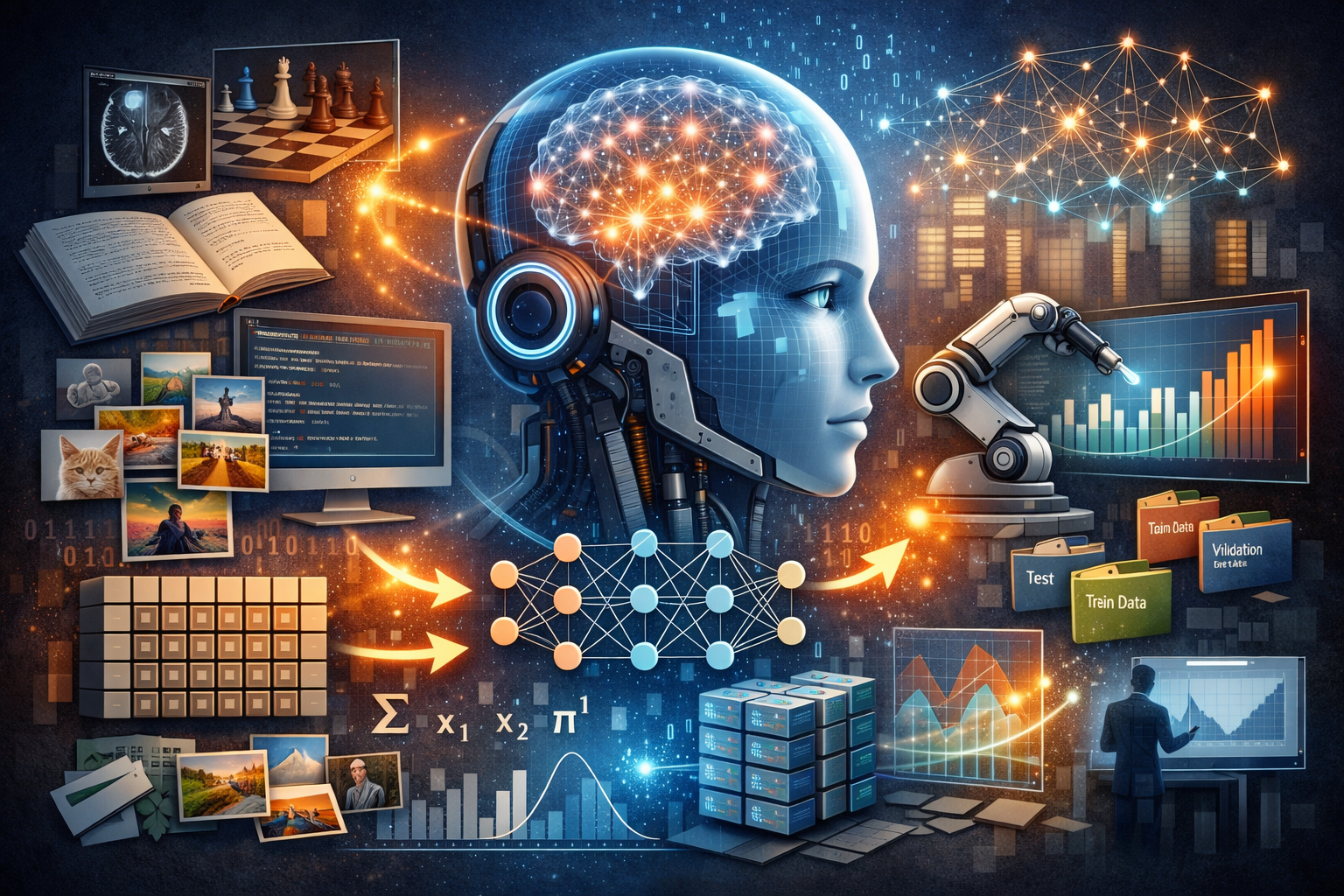
image courtesy of Gen AI - prompt author
Introduction:
Modern artificial intelligence is often described as if it were mysterious: a machine that writes, recognises images, recommends music, diagnoses disease, translates languages, and answers questions with apparent fluency. Yet behind this impressive behaviour lies a set of computational ideas that can be understood with patience and precision. Contemporary AI systems are not minds in the human sense. They are mathematical models trained to detect patterns in data and to use those patterns to make predictions, classifications, or generations.
For first-year computer science students, the most important insight is that modern AI is built on familiar foundations: data structures, algorithms, probability, optimisation, linear algebra, and software engineering. A large language model, an image classifier, or a speech recogniser may appear extraordinary at the surface. Still, internally it performs operations on numbers, often as vectors and matrices. Its intelligence emerges from the scale, organisation, and training of these operations rather than from explicit human-written rules.
From Rules to Learning:
Early approaches to artificial intelligence often relied on symbolic rules. A programmer might attempt to encode expert knowledge directly: if certain symptoms are present, suggest a diagnosis; if a chess position has a particular structure, prefer a certain move. Such systems could be powerful within narrow domains, but they were brittle. They struggled when the world became ambiguous, noisy, or too complex to describe with hand-written instructions.
Modern AI is largely based on machine learning. Instead of writing every rule by hand, engineers define a model architecture and a learning procedure. The system is then exposed to many examples, and it adjusts its internal numerical parameters so that its outputs become more useful. In this sense, the programmer no longer specifies every answer; rather, the programmer specifies how the machine should learn from experience.
Data - The Raw Material of AI:
Data is the raw material from which modern AI systems learn. For a text model, data may consist of books, articles, web pages, code, and conversations. For a medical imaging model, it may consist of labelled scans. For a recommendation system, it may include records of user behaviour. The model does not understand these items as humans do. It receives them as structured numerical input, and through training it discovers statistical regularities.
The quality of the data is as important as its quantity. A model trained on incomplete, biased, duplicated, or misleading examples can reproduce those flaws. Consequently, data preparation is a central part of AI engineering. It may involve cleaning corrupted records, removing duplicates, balancing classes, filtering unsafe content, anonymising personal information, and dividing examples into training, validation, and test sets. These practices are not peripheral; they strongly influence how the finished system behaves.
Representing the World as Numbers:
Computers operate on numbers, so AI systems must convert the world into numerical form. In language models, text is first divided into units called tokens. A token may be a word, part of a word, or sometimes a single character. Each token is then mapped to a vector, a list of numbers that represents it in a high-dimensional space. These vectors are called embeddings.
Embeddings are useful because they allow relationships to be expressed geometrically. Words or concepts with similar uses can have vectors that are close together. Images, sounds, and other inputs can also be represented as vectors. Once information is represented numerically, a model can transform it through layers of computation, gradually producing more abstract representations. In effect, the system learns a mathematical language in which patterns become easier to manipulate.
Neural Networks and Parameters:
The dominant models in contemporary AI are neural networks. Despite the biological name, artificial neural networks are not detailed simulations of brains. They are layered mathematical functions. A simple neuron receives input numbers, multiplies them by learned weights, adds a bias, and passes the result through an activation function. A network contains many such operations arranged in layers.
The weights and biases are called parameters. They determine how the model transforms its input into an output. In a small network, there may be thousands of parameters; in modern large models, there may be billions. Training is the process of finding parameter values that make the model perform well on a task. One may think of the architecture as the shape of the machine, and the parameters as the settings learned from data.
Training - Learning by Optimisation:
Training begins with a model whose parameters are usually initialised to small random values. The model is given an input and produces an output. This output is compared with a desired answer using a loss function, which assigns a numerical penalty to errors. For example, if a language model is trained to predict the next token in a sentence, the loss is high when it gives low probability to the correct next token.
The central question is how to adjust millions or billions of parameters so that the loss decreases. The usual answer is gradient descent and its variants. A gradient indicates the direction in which each parameter should be changed to reduce the loss. Backpropagation efficiently computes these gradients through the layers of the network. Repeated many times over vast quantities of data, this process slowly shapes the model into a system that captures useful regularities.
Training is computationally expensive. It requires powerful hardware, distributed systems, large memory capacity, and careful monitoring. Engineers must choose learning rates, batch sizes, regularisation methods, and stopping criteria. These choices affect not only accuracy, but also stability, cost, energy consumption, and the risk of overfitting, where a model performs well on training examples but poorly on unfamiliar data.
Transformers and the Attention Mechanism:
Many of the most influential AI systems today are based on the transformer architecture. Transformers are especially powerful for sequences such as text, code, audio, and even image patches. Their defining idea is attention, a mechanism that allows the model to decide which parts of the input are most relevant to each other. In a sentence, for instance, the meaning of a pronoun may depend on a noun several words earlier. Attention gives the model a way to represent such relationships directly.Self-attention compares tokens within the same input sequence. Each token is transformed into query, key, and value vectors. Roughly speaking, a query asks what information is needed, a key indicates what information a token can offer, and a value contains the information to be passed onward. By comparing queries and keys, the model assigns attention weights and forms a weighted combination of values. Multi-head attention repeats this process several times in parallel, allowing the model to capture different kinds of relationships simultaneously.
Transformers also use positional information, because attention alone does not inherently know the order of tokens. Positional encodings or learned positional embeddings supply this missing structure. In addition, transformer blocks usually contain feed-forward layers, residual connections, and normalisation steps. The result is an architecture that can process sequences efficiently and learn subtle contextual dependencies at scale.
Generative AI and Prediction:
Generative AI systems create new outputs: text, images, code, music, or video. In the case of large language models, generation is often based on next-token prediction. Given a context, the model estimates a probability distribution over possible next tokens. It then selects one token according to a decoding strategy and repeats the process. A paragraph emerges one token at a time. This predictive framing is deceptively simple. To predict the next token well across many contexts, a model must learn grammar, facts, style, programming patterns, reasoning shortcuts, and many associations present in its training data. However, prediction is not the same as understanding in a philosophical or human sense. The system may produce fluent language while still making mistakes, inventing unsupported claims, or failing at tasks requiring exact symbolic reasoning.Inference: Using a Trained Model:
Once training is complete, the model can be used for inference. Inference means applying the trained model to new inputs. When a user asks a chatbot a question, uploads an image for classification, or requests a translation, the system is performing inference. It is no longer learning its basic parameters from scratch; it is using what was learned during training to produce an output.
Inference must often be fast, reliable, and economical. Large models can be expensive to run because each output requires many matrix operations. Engineers therefore use techniques such as batching, caching, model compression, quantisation, and specialised hardware. The quality of an AI product depends not only on the model’s training, but also on how efficiently and safely it is deployed.
Fine-Tuning, Alignment, and Human Feedback:
Many modern systems are first pre-trained on broad data and then adapted for particular purposes. Fine-tuning adjusts the model on a narrower dataset, such as legal documents, medical questions, programming examples, or customer-support conversations. This allows a general model to become more useful in a specialised domain without training an entirely new system from the beginning.
Alignment is the broader attempt to make a model’s behaviour conform to human intentions, instructions, and safety constraints. This may include supervised examples of helpful answers, preference data collected from human reviewers, automated evaluations, and rule-based safeguards. Alignment is necessary because a model trained merely to imitate patterns in data may produce outputs that are irrelevant, unsafe, biased, or misleading. The goal is not only capability, but responsible usefulness.
Evaluation and Generalisation:
Evaluation asks whether an AI system works as intended. This is more difficult than it first appears. A model may achieve high accuracy on a benchmark yet fail in the messy conditions of real use. Good evaluation therefore combines quantitative tests, human review, stress testing, adversarial examples, and monitoring after deployment.The concept of generalisation is central. A system generalises when it performs well on data it has not seen before. In computer science terms, this is the difference between memorising a lookup table and learning a reusable pattern. Modern AI systems often generalise impressively, but not perfectly. They may be sensitive to small changes in wording, unusual inputs, or situations not well represented in the training data.
Limitations, Risks, and Responsibilities:
Although modern AI systems are powerful, they have significant limitations. They can generate plausible but false statements, reflect biases in training data, fail to explain their reasoning, and behave unpredictably outside familiar contexts. Their internal representations are difficult to interpret, especially when models contain billions of parameters. This opacity makes debugging and accountability challenging.
There are also social and ethical responsibilities. AI systems can affect hiring, education, policing, healthcare, finance, and public communication. Errors in such domains may have serious consequences. Computer scientists must therefore study not only algorithms, but also fairness, privacy, security, transparency, and governance. Building AI is not merely a technical activity; it is a civic one.
The Engineering Stack Behind AI:
A working AI system is more than a trained model. It is part of a larger engineering stack. Data pipelines collect and prepare examples. Training infrastructure distributes computation across accelerators. Evaluation systems measure performance. Deployment platforms serve the model to users. Monitoring tools detect drift, failures, misuse, and cost spikes. Security systems protect data and prevent abuse.This engineering perspective is important for students. The impressive behaviour of AI systems depends on algorithms, but also on databases, networks, operating systems, compilers, distributed computing, human-computer interaction, and software maintenance. Modern AI is therefore not a separate island within computer science. It is a synthesis of many parts of the discipline.
Conclusion:
Modern AI systems work by converting data into numerical representations, transforming those representations through learned mathematical structures, and optimising enormous sets of parameters so that useful behaviour emerges. Neural networks provide the basic modelling framework; transformers and attention mechanisms have become especially influential because they handle context and sequence with remarkable effectiveness. Training teaches the model; inference uses the trained model; fine-tuning and alignment adapt it to human needs.
For first-year computer science students, the lesson is both humbling and encouraging. AI is not magic. It is computation at scale, guided by mathematical principles and constrained by engineering realities. To understand it well, one must study algorithms, probability, linear algebra, data, systems, and ethics. The field will continue to change, but these foundations will remain essential. Those who learn them carefully will be prepared not only to use AI systems, but also to question, improve, and responsibly build the next generation of them.
Watch The Video