Meta Held Accountable for Teen Harm: How a Court Verdict Forced Industry Change
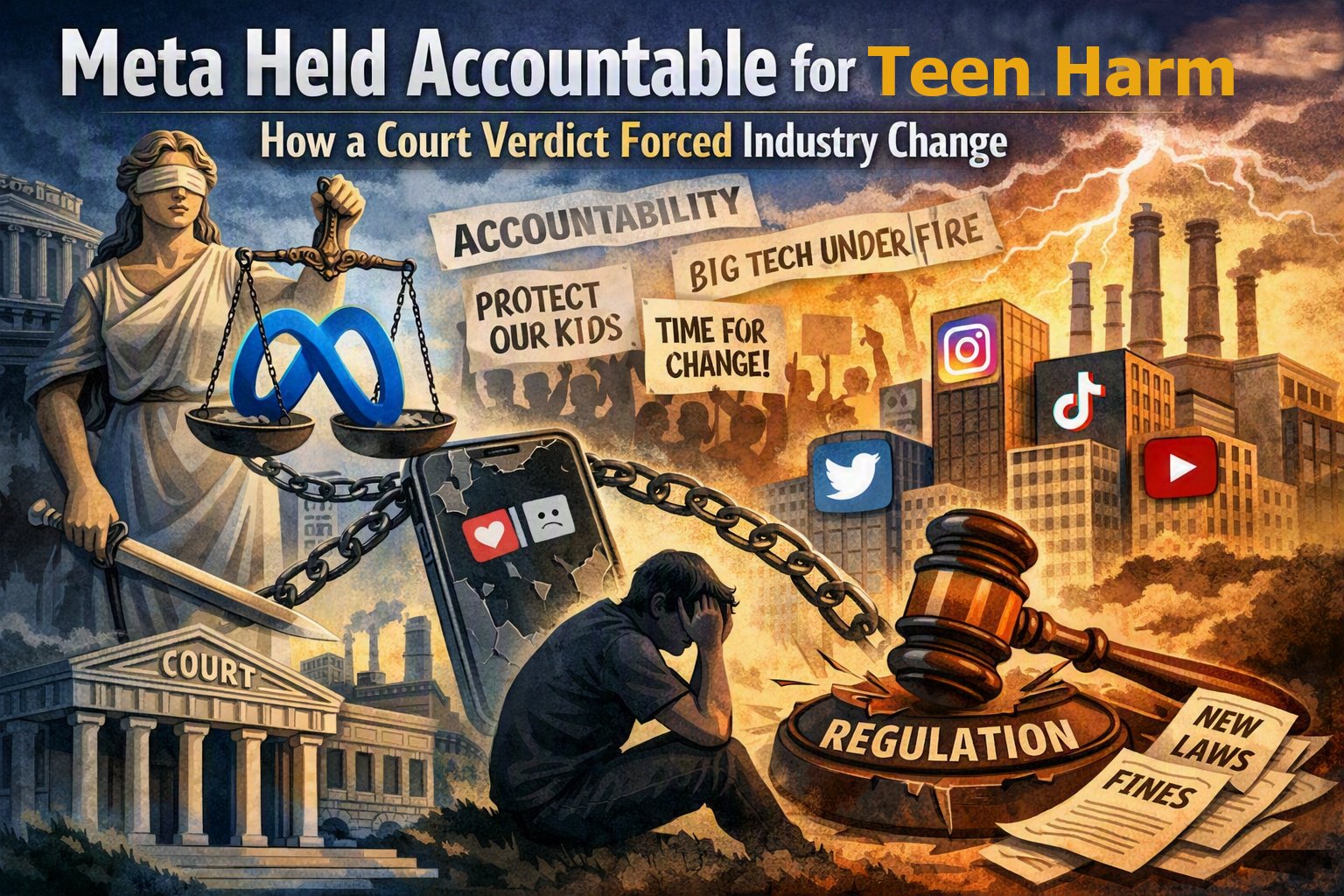
image courtesy of Gen AI - prompt author
On 26 August 2026, the long-running public and regulatory debate over social media’s effects on young people reached a pivotal moment. After years of public concern, investigative reporting, whistleblower disclosures and legislative hearings, a court accepted a proposed settlement requiring Meta - the parent company of Facebook and Instagram - to agree to remedies and commitments valued at $16.68 billion. The settlement, together with Meta’s contemporaneous statements, crystallised a legal and moral judgment: courts had internalised the externalities of social platforms - the harms borne by teenagers and their families - and compelled a major technology company to change its product design and corporate practices.
This essay examines the significance of that moment. It situates the settlement in the arc of public debate and litigation, explains the remedies the company agreed to implement, analyses why the court’s intervention mattered where other forums had not, and reflects on the broader implications for corporate accountability, regulatory strategy, and the governance of digital childhoods. The analysis is grounded in the public record and contemporary reporting of the settlement and its terms.
From Public Concern to Judicial Reckoning
For more than a decade, concerns about social media and adolescents circulated through multiple channels. Parents reported behavioural changes and mental health struggles; educators documented attention and learning impacts; researchers published studies linking platform use to anxiety, depression, and body image problems for some teens; and investigative journalists and whistleblowers disclosed internal company research and deliberations that suggested platform design choices amplified engagement at the expense of young users’ wellbeing. Legislatures held hearings; regulators issued guidance; and civil society groups campaigned for reform. Yet, despite this torrent of evidence and advocacy, the companies’ public posture remained largely unchanged: they emphasised the complexity of causation, disputed the magnitude of harms, pointed to user choice and parental responsibility, and highlighted incremental product changes and safety features as evidence of good faith.
The litigation that culminated in the August 2026 settlement differed in one crucial respect: it brought contested claims into a forum where evidence was tested under oath, where internal documents could be compelled and scrutinised, and where legal remedies - not merely public pressure or reputational risk - could be imposed. The court’s acceptance of the proposed settlement signalled that the harms alleged were no longer merely matters of public debate; they were legally cognizable externalities that the company would be required to address through concrete, enforceable measures.
What the Settlement Required
Meta’s public statement issued the same day as the court’s action set out a set of concrete commitments that, if implemented, would alter the user experience for teenagers in measurable ways. Among the principal measures were:
- A two-hour daily time limit for teen accounts;
- Automatic app access shutdown at night to prevent late-night use;
- No notifications during school hours to reduce distraction and preserve instructional time;
- Regular prompts to teens every 15 minutes of continuous screen time to encourage breaks;
- Expanded parental supervision controls enabling guardians to set and manage how teens use the apps.
Meta framed these measures as an industry standard that would be most effective if adopted across platforms, explicitly calling for collaboration with peers such as TikTok and YouTube. The company’s appeal for cross-platform adoption underscored a familiar tension: unilateral action by one firm can create competitive disadvantages if rivals do not follow suit, but collective adoption can raise the floor for safety while preserving competitive parity.
Why the Court’s Role Was Decisive
Several features of the judicial process made the court’s intervention decisive in ways that other venues had not been.
- 1. Evidentiary rigour and access to internal documents. Litigation compelled discovery of internal research, product metrics, and communications that had previously been shielded from public view. Where journalists and whistleblowers had revealed fragments, the court process allowed for the systematic presentation and cross-examination of evidence. This transformed the debate from competing narratives into a record that could be evaluated against legal standards.
- 2. Enforceable remedies. Unlike voluntary pledges or regulatory guidance, a court-approved settlement can include specific, enforceable obligations, timelines, and monitoring mechanisms. The remedies in this case were not merely aspirational; they were concrete product changes and parental control features that Meta agreed to implement, and that could be monitored for compliance.
- 3. Internalisation of externalities. The court’s judgment effectively required Meta to internalise costs that had previously been external to its business calculus. Where the company had optimised for engagement and advertising revenue, the settlement forced a rebalancing of incentives by making certain safety features part of the cost of doing business.
- 4. Precedential and signalling effects. A high-profile judicial resolution signals to other firms, investors, and policymakers. It demonstrates that the legal system can and will hold platforms accountable for foreseeable harms, thereby altering the risk calculus for corporate boards and product teams.
These features combined to make the court’s action more than a single case outcome; it became a structural intervention in the governance of social media.
The Substance of the Remedies: Design, Agency, and the Role of Parents
The remedies the settlement required are notable for their focus on product design and family agency. They do not attempt to micromanage content moderation or to prescribe particular speech outcomes; rather, they aim to change the conditions of use that shape attention, habit formation, and exposure.
Design interventions.
Time limits, nighttime shutdowns, and notification silences are design levers that alter the affordances of the platform. They recognise that engagement is not merely a function of user preference but is shaped by defaults, nudges, and the architecture of attention. By changing defaults and adding friction at key moments, these measures seek to reduce compulsive patterns and create space for offline life.
Parental controls and agency.
The settlement’s emphasis on parental supervision tools reflects a policy choice: to empower guardians to set boundaries rather than to rely solely on platform paternalism or on state regulation. This approach respects family autonomy while acknowledging that many parents lack the technical means or knowledge to manage complex app ecosystems. Better tools can shift responsibility from ad hoc workarounds to integrated controls.
Behavioural prompts.
Regular prompts every 15 minutes of continuous use are a behavioural design intended to interrupt prolonged sessions and encourage reflection. While modest in isolation, such prompts can cumulatively change usage patterns and create opportunities for self-regulation.
Taken together, these remedies embody a design philosophy that treats safety as a product requirement rather than an optional add on. They also reflect a pragmatic compromise: rather than banning features or fundamentally altering business models, the settlement seeks to mitigate harms through targeted, implementable changes.
Corporate Rhetoric and the Limits of Voluntary Reform:
Meta’s public statement accompanying the settlement contained an implicit admission: the company recognised that unilateral action would be less effective if competitors did not adopt similar measures. That admission reveals the structural constraint that has long shaped platform behaviour. When user attention is the primary monetizable commodity, firms face a collective action problem: any one company that reduces engagement risks losing market share and advertising revenue unless rivals follow suit.
This dynamic helps explain why voluntary reforms and industry codes have often fallen short. Companies may announce safety features and research initiatives, but absent enforceable obligations and cross-platform coordination, incentives favour incrementalism. The court’s intervention changed that calculus by making certain safety measures part of a legally enforceable settlement, thereby reducing the competitive penalty for adopting them.
Yet the settlement also exposes a deeper question: can private litigation and settlements substitute for public regulation in addressing systemic harms? The answer is mixed. Litigation can compel disclosure and produce tailored remedies, but it is reactive and case-specific. Comprehensive public policy - informed by evidence and democratic deliberation - remains necessary to set baseline protections, ensure equitable enforcement, and address harms that transcend any single company. The settlement is therefore a critical step, but not the final word.
Measuring Success: Compliance, Evaluation, and Unintended Consequences
A settlement’s promise is only as good as its implementation and evaluation. Three issues will determine whether the August 2026 agreement produces meaningful change.
Will the technical measures be implemented as described, and will they be robust across devices, operating systems, and international jurisdictions? Implementation requires engineering resources, clear specifications, and monitoring mechanisms to ensure that features work as intended and are not easily circumvented.
To assess impact, independent researchers must be able to measure changes in usage patterns, mental health outcomes, educational engagement, and other relevant metrics. The settlement should therefore include provisions for data access, transparency, and third-party evaluation so that claims about effectiveness can be tested empirically.
Design changes on one platform can produce displacement effects: teens may migrate to other apps, adopt workarounds, or shift to private messaging channels where harms are harder to observe and address. Cross-platform coordination and broader policy frameworks are necessary to mitigate such displacement.
If the settlement includes enforceable monitoring, data sharing provisions, and mechanisms for iterative improvement, it can generate a model for evidence-based product safety. If it lacks these features, the risk is that the measures will be symbolic rather than transformative.
Broader Implications for Corporate Accountability and Public Policy
The August 2026 settlement has implications that extend beyond Meta and the specific remedies it adopted.
Legal precedent and corporate governance:
The case demonstrates that corporate boards and executives can be held accountable for foreseeable harms arising from product design. This will influence fiduciary deliberations, risk assessments, and investor expectations. Firms will need to weigh the legal and reputational costs of design choices more explicitly.
Regulatory complementarities:
Litigation and settlements can complement regulatory action by producing detailed findings and practical remedies. Policymakers can draw on the evidentiary record to craft legislation that sets baseline protections, mandates transparency, and establishes enforcement mechanisms that apply across the industry.
Norms of design ethics:
The case elevates the idea that ethical design is not merely aspirational but a legal and commercial imperative. Universities, professional associations, and industry groups will likely intensify efforts to codify design ethics and to train practitioners in safety-oriented product development.
Global governance challenges:
Digital platforms operate across jurisdictions with divergent legal standards. The settlement’s reach will therefore depend on how its terms are implemented internationally and whether other jurisdictions adopt complementary rules. International cooperation and harmonisation will be important for preventing regulatory arbitrage and protecting children globally.
Conclusion: A Moment of Accountability, Not an Endpoint
The court’s acceptance of the proposed $16.68 billion settlement on 26 August 2026 marked a consequential moment in the governance of digital childhoods. It converted years of public concern and investigative exposure into enforceable obligations that require concrete product changes. By compelling Meta to internalise costs and to redesign aspects of its platforms for teen users, the judicial process addressed a collective action problem that voluntary industry measures had failed to solve.
Yet the settlement is not an endpoint. Its ultimate value will be judged by implementation, independent evaluation, and the degree to which it catalyses broader policy and industry change. The case demonstrates the power of legal institutions to translate evidence into remedies, but it also underscores the limits of litigation as a solitary tool. Durable protection for children in the digital age will require a multi-pronged approach: enforceable legal remedies, transparent corporate practice, independent research, and public policy that sets clear standards and accountability mechanisms.
For scholars, practitioners, and policymakers, the August 2026 settlement offers both a precedent and a laboratory. It shows that when externalities are internalised, companies can be compelled to change; it also invites rigorous study of whether those changes produce the intended social benefits. The task now is to ensure that the remedies are implemented faithfully, evaluated transparently, and refined in light of evidence - so that the promise of accountability becomes a durable reality for the young people whose lives are shaped by these platforms.
Watch The Video